Group Functions
What Are Group Functions?
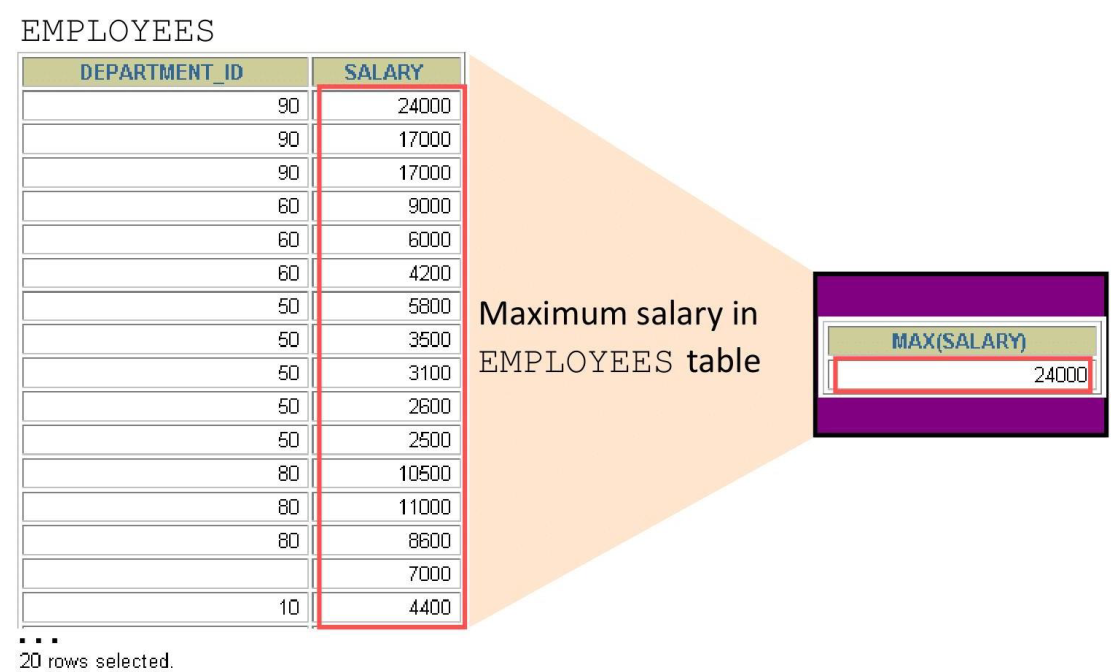
Group functions operate on sets of rows to give one result per group.
Types of Group Functions
- AVG
- COUNT
- MAX
- MIN
- STDDEV
- SUM
- VARIANCE
Group Functions: Syntax
SELECT     [column,] group_function(column), ...
FROM       table
[WHERE     condition]
[GROUP BY  column]
[ORDER BY  column];
Using the AVG and SUM Functions
SELECT AVG(salary), MAX(salary),
        MIN(salary), SUM(salary)
        FROM nikovits.employees
WHERE job_id LIKE '%REP%';
| AVG(SALARY) |
MAX(SALARY) |
MIN(SALARY) |
SUM(SALARY) |
| 8272.727272727272727 |
11500 |
6000 |
273000 |
Using the MIN and MAX Functions
SELECT MIN(hire_date), MAX(hire_date)
FROM nikovits.employees;
| MIN(HIRE_DATE) |
MAX(HIRE_DATE) |
| 17/06/87 |
21/04/00 |
Using the COUNT Function
COUNT(*) returns the number of rows in a table:
SELECT COUNT(*)
FROM nikovits.employees
WHERE department_id = 50;
COUNT(expr) returns the number of rows with non-null values for expr:
SELECT COUNT(commission_pct)
FROM nikovits.employees
WHERE department_id = 80
Using the DISTINCT Keyword
- COUNT(DISTINCT expr) returns the number of distinct non-null values of the expr.
- To display the number of distinct department values in the nikovits.employees table:
SELECT COUNT(DISTINCT department_id)
FROM nikovits.employees;
| COUNT(DISTINCT DEPARTMENT_ID) |
| 11 |
Group Functions and Null Values
Group functions ignore null values in the column:
SELECT AVG(commission_pct)
FROM nikovits.employees;
| AVG(COMMISSION_PCT) |
| .2228571428571428571 |
The NVL function forces group functions to include null values:
SELECT AVG(NVL(commission_pct, 0))
FROM nikovits.employees;
| AVG(NVL(COMMISSION_PCT,0)) |
| .0728971962616822429906542 |