Relational Algebra
Relation Algebra
A relational algebra calculator - RelaX
- https://dbis-uibk.github.io/relax/landing
- An online tool designed to help users learn and practice relational algebra by executing queries and visualizing the results
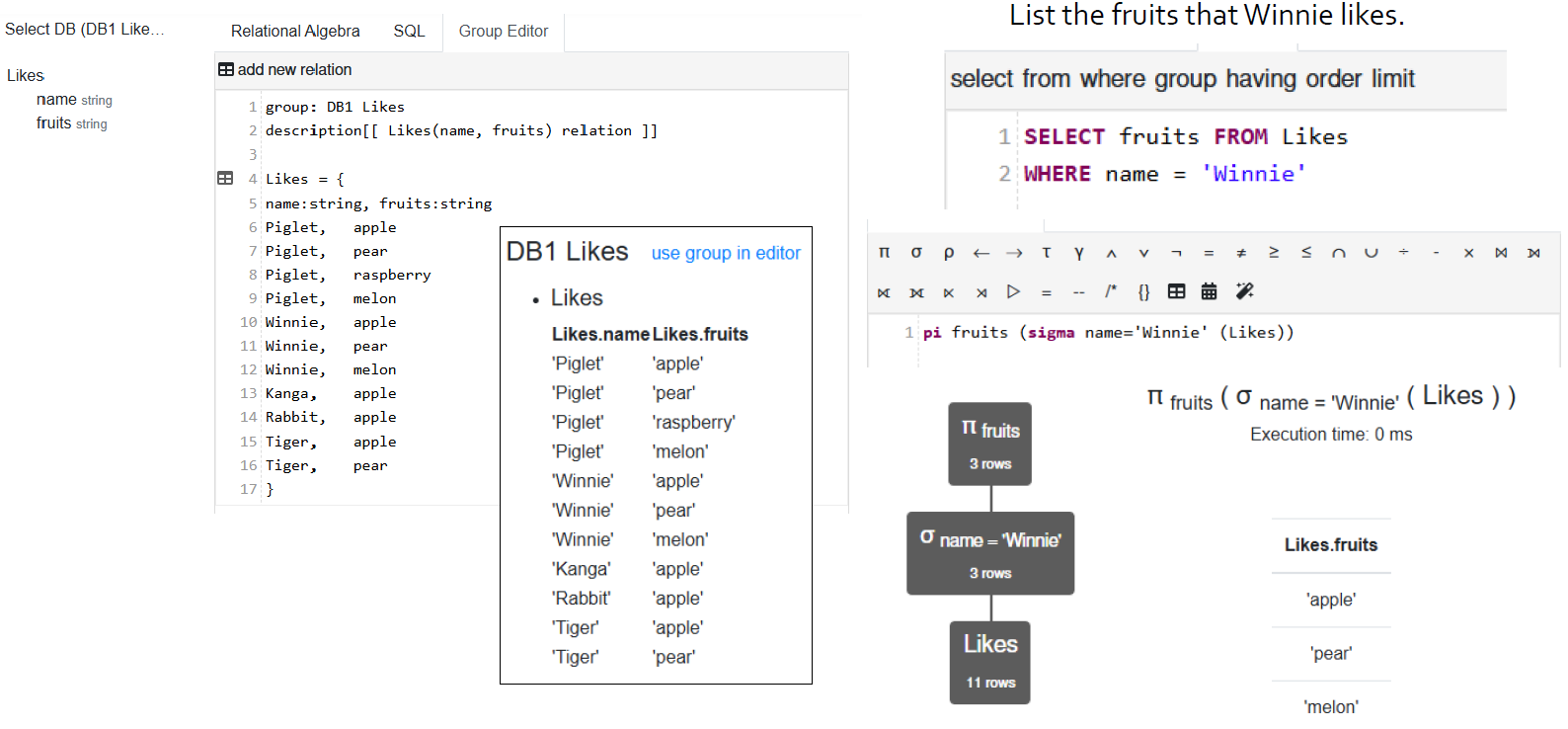
- How to create relations and insert tuples into them:
- Click on 'Group Editor' tab
- Copy into 'Group Editor' window your data. Find below my examples!
- Click on "preview" button then double click on "use Group in editor" button
- Now you can run your queries clicking on 'Relational Algebra' or 'SQL' tab.
- This implementation allows only sets and not multisets.
- There are differences between Oracle and Relax SQL syntax.
- Name of a relation is case-sensitive.
RelaX Example
RelaX Website
(Free online tool to practice relational algebra expressions with instant results and SQL comparison.)
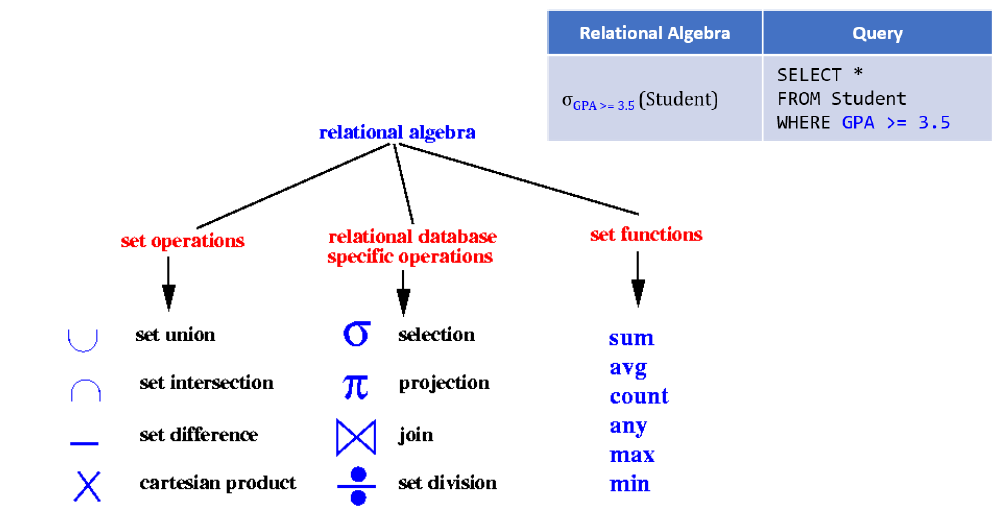
Core Relational Algebra
- Union, intersection, and difference.
- Usual set operations, but both operands must have the same relation schema.
- Selection: picking certain rows.
- Projection: picking certain columns.
- Products and joins: compositions of relations.
- Renaming of relations and attributes.
Union, intersection, difference
- \( R \cup S \)
SELECT ... UNION SELECT ...;- (Duplicate elimination: UNION ALL: multiset, UNION: set)
- \( R \cap S \)
SELECT ... INTERSECT SELECT ...;
- \( R - S \)
SELECT ... MINUS SELECT ...;- (Some DBMS uses EXCEPT)
Selection
- \( R1 := \sigma_{C}(R2) \)
- \( C \) is a condition (as in "if" statements) that refers to attributes of \( R2 \).
- \( R1 \) is all those tuples of \( R2 \) that satisfy \( C \).
SELECT * FROM R2 WHERE C;
Projection
- \( R1 := \pi_{L}(R2) \)
- \( L \) is a list of attributes from the schema of \( R2 \).
- \( R1 \) is constructed by looking at each tuple of \( R2 \), extracting the attributes on list \( L \), in the order specified, and creating from those components a tuple for \( R1 \).
- Eliminate duplicate tuples, if any.
SELECT DISTINCT L FROM R2;
Extended Projection
- Using the same \( \pi_L \) operator, we allow the list \( L \) to contain arbitrary expressions involving attributes:
- Arithmetic on attributes, e.g., \( A+B \rightarrow C \).
- Duplicate occurrences of the same attribute.
SELECT A+B AS C FROM R;- (AS -> optional)
Product
- \( R3 := R1 \times R2 \)
- Pair each tuple \( t1 \) of \( R1 \) with each tuple \( t2 \) of \( R2 \).
- Concatenation \( t1t2 \) is a tuple of \( R3 \).
- Schema of \( R3 \) is the attributes of \( R1 \) and then \( R2 \), in order.
- But beware attribute \( A \) of the same name in \( R1 \) and \( R2 \): use \( R1.A \) and \( R2.A \).
SELECT * FROM R1, R2;orSELECT * FROM R1 CROSS JOIN R2;
Theta-Join
- \( R3 := R1 \bowtie_{C} R2 \)
- Take the product \( R1 \times R2 \).
- Then apply \( \sigma_{C} \) to the result.
- As for \( \sigma \), \( C \) can be any boolean-valued condition.
- Historic versions of this operator allowed only \( A\ \theta\ B \), where \( \theta \) is \( =, < \), etc.; hence the name "theta-join."
SELECT * FROM R1 JOIN R2 ON (C);
Natural Join
- A useful join variant (natural join) connects two relations by:
- Equating attributes of the same name, and
- Projecting out one copy of each pair of equated attributes.
- Denoted \( R3 := R1 \bowtie R2 \).
SELECT * FROM R1 NATURAL JOIN R2;
Renaming
- The \( \rho \) operator gives a new schema to a relation.
- \( R1 := \rho_{R1(A1, ..., An)}(R2) \) makes \( R1 \) be a relation with attributes \( A1, ..., An \) and the same tuples as \( R2 \).
- Simplified notation: \( R1(A1, ..., An) := R2 \).
SELECT X1 A1, X2 A2, ... Xn An FROM R2;CREATE TABLE R1 AS SELECT X1 A1, X2 A2, ... Xn An FROM R2;
Sequences of Assignments
- Create temporary relation names.
- Renaming can be implied by giving relations a list of attributes.
- Example: \( R3 := R1 \bowtie_{C} R2 \) can be written:
- \( R4 := R1 \times R2 \) (
CREATE TABLE R4 ...) - \( R3 := \sigma_{C}(R4) \) (
SELECT ... FROM R4 ...)
- \( R4 := R1 \times R2 \) (
Expressions in a Single Assignment
- Example: the theta-join \( R3 := R1 \bowtie_{C} R2 \) can be written:
- \( R3 := \sigma_{C}(R1 \times R2) \)
- Precedence of relational operators:
- \( [\sigma, \pi, \rho] \) (highest).
- \( [\times, \bowtie] \).
- \( \cap \).
- \( [\cup, -] \).
The Extended Algebra
- \( \pi_{L} \) extended projection
- \( \delta \) = eliminate duplicates from bags.
- \( \tau \) = sort tuples.
- \( \gamma \) = grouping and aggregation.
- Outerjoin: avoids "dangling tuples" = tuples that do not join with anything.
Extended Projection
- Using the same \( \pi_{L} \) operator, we allow the list \( L \) to contain arbitrary expressions involving attributes:
- Arithmetic on attributes, e.g., \( A+B \rightarrow C \)
- "→" stands for renaming the attribute in the result to "\( C \)"
- Duplicate occurrences of the same attribute.
- Arithmetic on attributes, e.g., \( A+B \rightarrow C \)
SELECT A+B AS C FROM R;- ("AS" is optional)
Duplicate Elimination
- \( R1 := \delta(R2) \).
- \( R1 \) consists of one copy of each tuple that appears in \( R2 \) one or more times.
Sorting
- \( R1 := \tau_{L}(R2) \).
- \( L \) is a list of some of the attributes of \( R2 \).
- \( R1 \) is the list of tuples of \( R2 \) sorted first on the value of the first attribute on \( L \), then on the second attribute of \( L \), and so on.
- Break ties arbitrarily.
- \( \tau \) is the only operator whose result is neither a set nor a bag.
Aggregation Operators
- Aggregation operators are not operators of relational algebra.
- Rather, they apply to entire columns of a table and produce a single result.
- The most important examples: SUM, AVG, COUNT, MIN, and MAX.
- Example with Table \( R(A, B) \):
- \( SUM(A) = 7 \)
- \( COUNT(A) = 3 \)
- \( MAX(B) = 4 \)
- \( AVG(B) = 3 \)
- Example with Table \( R(A, B) \):
Grouping Operator
- \( R1 := \gamma_{L}(R2) \). \( L \) is a list of elements that are either:
- Individual (grouping) attributes.
- \( AGG(A) \), where \( AGG \) is one of the aggregation operators and \( A \) is an attribute.
- An arrow and a new attribute name renames the component.
Applying \( \gamma\ L\ (R) \)
- Group \( R \) according to all the grouping attributes on list \( L \).
- That is: form one group for each distinct list of values for those attributes in \( R \).
- Within each group, compute \( AGG(A) \) for each aggregation on list \( L \).
- Result has one tuple for each group:
- The grouping attributes and
- Their group’s aggregations.
Outer join
- Suppose we join \( R \bowtie_{C} S \).
- A tuple of \( R \) that has no tuple of \( S \) with which it joins is said to be dangling.
- Similarly for a tuple of \( S \).
- Outerjoin preserves dangling tuples by padding them NULL.
Examples
| Relational Algebra Expression | SQL Equivalent |
|---|---|
| \( \pi_{A, B+C \rightarrow X}(R) \) | SELECT A, B+C AS X FROM R; |
| \( \delta(R) \) | SELECT DISTINCT * FROM R; |
| \( R \cup S \) | SELECT * FROM R UNION ALL SELECT * FROM S; (multiset) |
| \( R \cap S \) | SELECT * FROM R INTERSECT ALL SELECT * FROM S; (!) |
| \( R - S \) | SELECT * FROM R MINUS ALL SELECT * FROM S; (!) |
| \( \delta(R \cup S) \) | SELECT * FROM R UNION SELECT * FROM S; (set) |
| \( \delta(R \cap S) \) | SELECT * FROM R INTERSECT SELECT * FROM S; (set) |
| \( \delta(R) - \delta(S) \) | SELECT * FROM R MINUS SELECT * FROM S; (set) |
| \( R \bowtie S \) | SELECT * FROM R NATURAL JOIN S; |
| \( R \bowtie_{\theta} S \) | SELECT * FROM R JOIN S ON (\theta); |
| \( R \times S \) | SELECT * FROM R CROSS JOIN S; or SELECT * FROM R, S; |
| \( \gamma_{A, SUM(B)}(R) \) | SELECT A, SUM(B) FROM R GROUP BY A; |
| \( \gamma_{A, COUNT(B)}(\delta \pi_{A,B} R) \) | SELECT A, COUNT(DISTINCT B) FROM R GROUP BY A; |
| \( \tau_{A, B+C}(R) \) | SELECT * FROM R ORDER BY A, B+C; |
| Outer join | SELECT * FROM R NATURAL LEFT OUTER JOIN S; |
| Outer join | SELECT * FROM R LEFT OUTER JOIN S ON R.B > S.D; |
Execution steps
Execution steps of a SELECT statement expressed in relational algebra:
- Replace all usages of the temporary-tables defined in the WITH-clause.
- \( \bowtie \) joins or product operations after FROM-clause.
- \( \sigma \) selection based on the WHERE-clause.
- \( \gamma \) creating groups and computing aggregations, based on GROUP BY-clause.
- \( \sigma \) selection for the groups or tuples created from the groups, based on HAVING-clause.
- \( \pi \) projection based on SELECT-clause.
- \( \rho \) rename result attributes based on AS keyword.
- \( \cup \cap - \) UNION, INTERSECT, MINUS set operations.
- \( \delta \) duplicate elimination if we have DISTINCT.
- \( \tau \) sorting based on ORDER BY clause.